
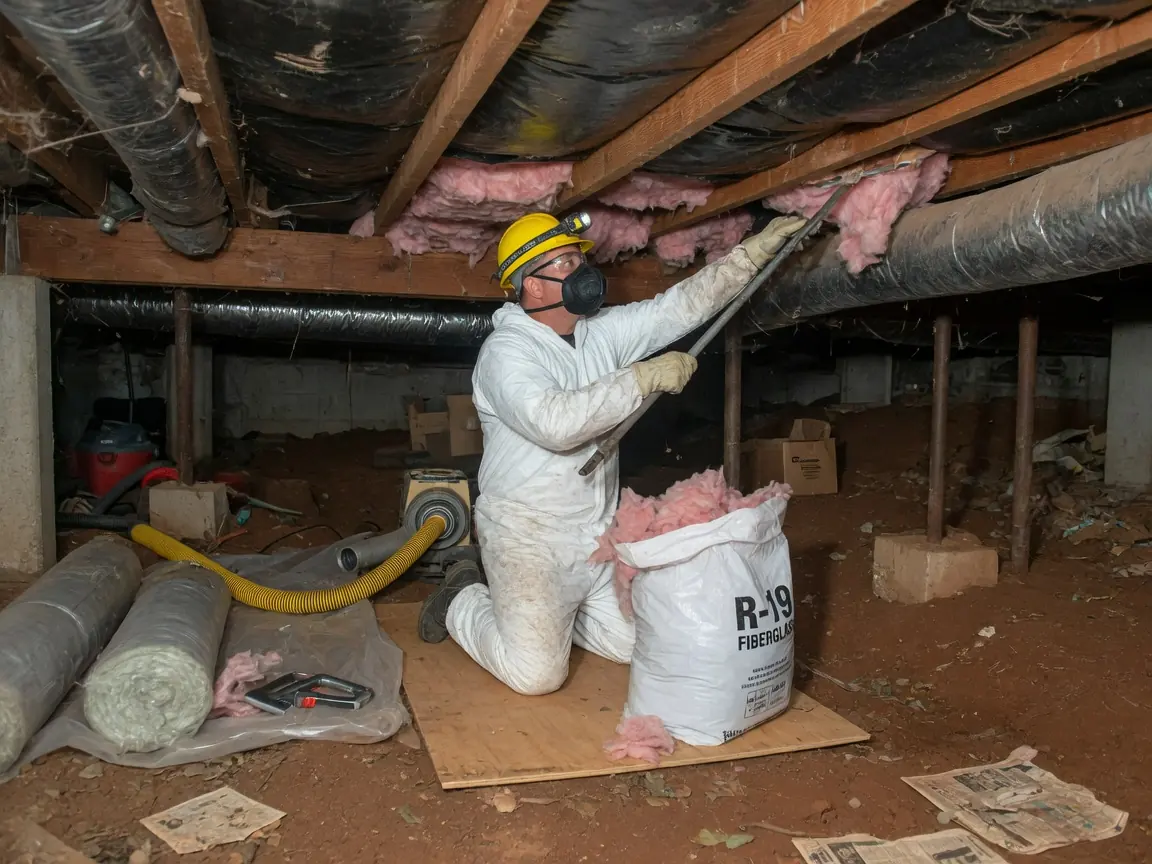
Walk into most vented crawl spaces in Tulsa and you will see the same thing: fiberglass batts that were stapled between the floor joists years ago, now sagging, soaked or lying on the dirt. In a humid climate those batts soak up moisture all summer, lose most of their value, and give mold a place to grow. Cold floors in January and high cooling bills in July often trace back to insulation that is no longer doing its job.
There are two ways to insulate a crawl space. In a vented crawl space, insulation goes in the floor between the joists, separating the house from the crawl space. In a sealed or encapsulated crawl space, insulation goes on the foundation walls and rim joists instead, so the crawl space becomes part of the conditioned house. Mixing the two approaches, or insulating the floor of a sealed crawl space, can cause condensation problems.
We look at the whole crawl space before recommending insulation, so the insulation matches how the space is vented, sealed and dried.
Tulsa tip: start with the rim joist
The rim joist, the band of framing that sits on top of the foundation wall, is often the leakiest part of an older home. Air sealing and insulating it with closed-cell spray foam or cut-and-sealed foam board is a relatively small job that makes a noticeable difference in drafts and floor comfort.
Signs You Need Crawl Space Insulation
- Batts hanging down or lying on the ground
- Cold floors in winter, especially over the crawl space
- Insulation that is wet, moldy or flattened
- Pipes that freeze during cold snaps
- Drafts along baseboards on outside walls
- Rodent nests or tunnels in old insulation
Choosing the Right Crawl Space Insulation
For a sealed crawl space, foundation wall insulation is the standard. Rigid foam board, such as polyiso or extruded polystyrene, is fastened to the walls, or closed-cell spray foam is applied to the walls and rim joists. Closed-cell foam is about R-6 to R-7 per inch and also acts as an air and vapor barrier, which is why it is popular for rim joists. The 2021 energy code calls for crawl space walls around R-5 continuous or R-13 cavity in climate zone 3, while floors over vented crawl spaces call for about R-13 to R-19; local requirements can differ, and we will confirm them for your home.
For a vented crawl space that will stay vented, R-19 batts or rigid board between the joists are common, but they must be supported with wire or netting so they stay tight to the subfloor, and the soil still needs a vapor barrier. In Tulsa, we usually recommend moving to a sealed crawl space with wall insulation instead, because floor insulation in a humid vented crawl space tends to fail.
Crawl Space Insulation Services We Help With
Old insulation removal
Bagging and hauling out wet, moldy or fallen batts and pest debris.
Rim joist air sealing and insulation
Closed-cell spray foam or sealed foam board on the band joist.
Foundation wall insulation
Rigid foam or spray foam on walls for sealed crawl spaces.
Floor insulation for vented crawl spaces
Supported batts or rigid board between joists.
Duct and pipe insulation
Insulating ducts and water lines that sweat or risk freezing.
Crawl Space Insulation Cost in Tulsa, OK
| Project | Typical Range | What Affects It |
|---|---|---|
| Old insulation removal | $1.00 to $2.00 per sq ft | Amount, condition, clearance |
| Rim joist spray foam | $800 to $2,000 per home | Perimeter length, access |
| Foam board on foundation walls | $2.00 to $4.00 per sq ft of wall | Board type and thickness |
| Closed-cell spray foam on walls | $2.50 to $5.00 per sq ft of wall | Thickness, prep |
| Floor batts with supports | $1.00 to $2.00 per sq ft | R-value, joist spacing |
| Typical 1,000 sq ft crawl space project | $1,500 to $4,000 | Approach and removal needed |
How It Works
- 1
Inspection
We check the existing insulation, venting, moisture and any mold or pests.
- 2
Removal and cleanup
Failed insulation and debris are removed and the space is cleaned.
- 3
Air seal and insulate
Rim joists are sealed and walls or floors are insulated to match the crawl space design.
- 4
Moisture check
Vapor barrier and humidity control are confirmed so the new insulation stays dry.