
Most Tulsa crawl spaces were built with foundation vents on the theory that moving air would keep them dry. In a mixed-humid climate that theory breaks down every summer. Warm outdoor air carrying a dew point near 70 degrees flows through the vents, meets ductwork and joists cooled by the air conditioning above, and condenses. The result is damp insulation, sweating ducts, mold on the framing and a musty smell that rises into the house.
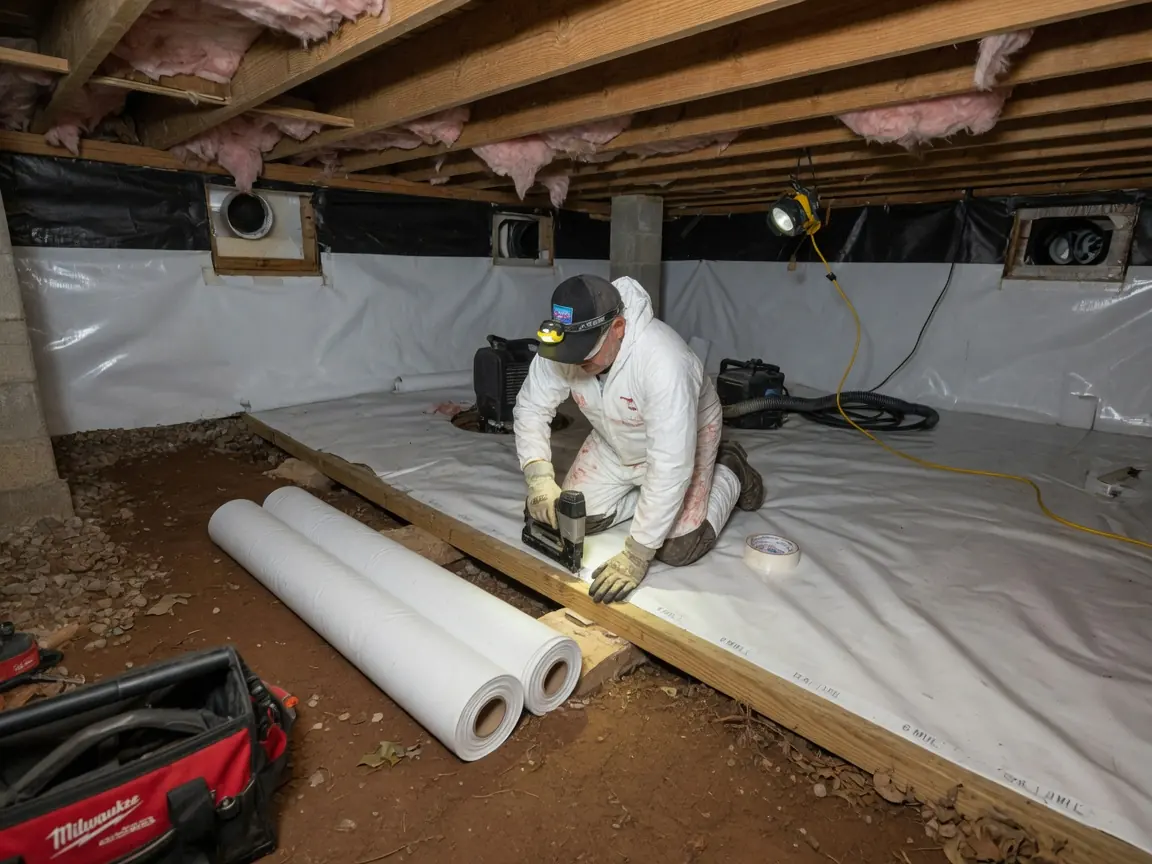
Crawl space encapsulation closes the space off from the outdoors and the soil. A heavy reinforced liner covers the dirt floor, runs up the foundation walls and wraps the piers, with every seam overlapped and sealed. Vents and gaps around the rim joist are closed, and a dehumidifier sized for the space holds humidity in a safe range. Done right, the crawl space behaves like a clean, dry part of the house instead of a damp cave.
We inspect the space first, deal with any water or mold problems that have to come first, and give you a written quote for the full system. Quotes are free, and you decide whether to move forward.
Tulsa tip: check for gas appliances first
If a gas furnace or water heater lives in the crawl space and pulls its combustion air from it, sealing the vents changes how that appliance breathes. We check this and plan for outside combustion air or a sealed-combustion unit before closing anything up.
Signs You Need Crawl Space Encapsulation
- Humidity readings above 60 percent for days at a time
- A musty smell in rooms over the crawl space
- Condensation dripping from ducts or cold water lines
- Mold, white fuzz or dark stains on joists
- Fiberglass insulation falling out of the floor
- Cupping hardwood floors in late summer
Choosing the Right Encapsulation System
The liner is the part you will live with for decades. Most quality systems use a 12 to 20 mil reinforced polyethylene liner; thicker material resists punctures from gravel and service traffic and lasts longer in a space people actually crawl through. The liner should extend up the foundation walls, be mechanically fastened near the top, and have seams overlapped several inches and sealed with tape or mastic. Piers should be wrapped, not just trimmed around.
Humidity control is the other half. The residential code allows an unvented crawl space when it has a sealed ground cover and a way to manage moisture, such as a dehumidifier, a small conditioned supply air duct or a continuously running exhaust fan. In Tulsa, a dedicated crawl space dehumidifier is the common choice. We always plan how it drains: gravity to the outside or a condensate pump, never onto the liner. We often insulate the foundation walls or rim joists at the same time, which is covered on the crawl space insulation page.
Crawl Space Encapsulation Services We Help With
Full floor and wall liner
12 to 20 mil reinforced liner over the soil, up the walls and around piers, with sealed seams.
Vent and rim sealing
Foundation vents closed with rigid covers and gaps along the rim joist air sealed.
Crawl space dehumidifier
A unit sized to the square footage with a proper condensate drain and a humidity setpoint.
Access door upgrade
An insulated, sealed access door so the system is not undone by a loose panel.
Debris and old insulation removal
Hauling out fallen batts, old plastic, wood scraps and pest debris before the liner goes down.
Moisture monitoring
A remote humidity sensor so you can check the crawl space from your phone.
Crawl Space Encapsulation Cost in Tulsa, OK
| Project | Typical Range | What Affects It |
|---|---|---|
| Encapsulation, floor and walls | $3.50 to $7.50 per sq ft | Liner thickness, wall height, pier count |
| Typical 1,200 sq ft crawl space | $5,000 to $9,500 | Includes liner, sealing and dehumidifier |
| Crawl space dehumidifier, installed | $1,500 to $3,000 | Capacity, drain route, new circuit |
| Sealed access door | $300 to $900 | Size, framing, insulation |
| Debris and insulation removal | $1.00 to $2.00 per sq ft | Amount of material, clearance |
| Sump pump if water is present | $1,200 to $2,500 | Discharge route, battery backup |
How It Works
- 1
Inspection and moisture readings
Humidity, wood moisture, standing water, vents, insulation and any gas appliances are checked and photographed.
- 2
Prep work
Water problems, mold and debris are handled first so the liner is not sealing in a problem.
- 3
Liner, sealing and equipment
The liner goes down and up the walls, vents and rim are sealed, and the dehumidifier is installed and drained.
- 4
Walkthrough and settings
You see the finished space, learn the dehumidifier setpoint and how to keep the system working.